Houseplant Pests: 6 Common Bugs and How to Check Them
Filip Leszczyński 16 October 2026 12 min read
In this article
Houseplant pests are easiest to beat when you name the bug before you treat it. Move the suspect plant away from the others, check the leaf undersides and stem joints with a hand lens, and photograph what you find; a rinse or careful wipe is often the first useful move.
The six usual suspects indoors are aphids, mealybugs, scale, thrips, spider mites and fungus gnats. They hide in different places, they leave different marks, and they do not respond to the same fixes. A spray picked because a leaf looks bad can miss the real pest and damage a plant that had no pest at all.
Here is the catch most people miss: the leaf that looks worst may no longer hold the culprit. Feeding scars stay after the insects move on, so you judge progress by live bugs, not by how tidy the old leaves look.
Bugs on indoor plants: where do they hide?
Bugs on indoor plants hide where you are not looking: leaf undersides, stem joints, the tight new growth at the tip and the sheaths where a leaf wraps the stem. Check more than one leaf, in bright daylight, with a hand lens if you have one.
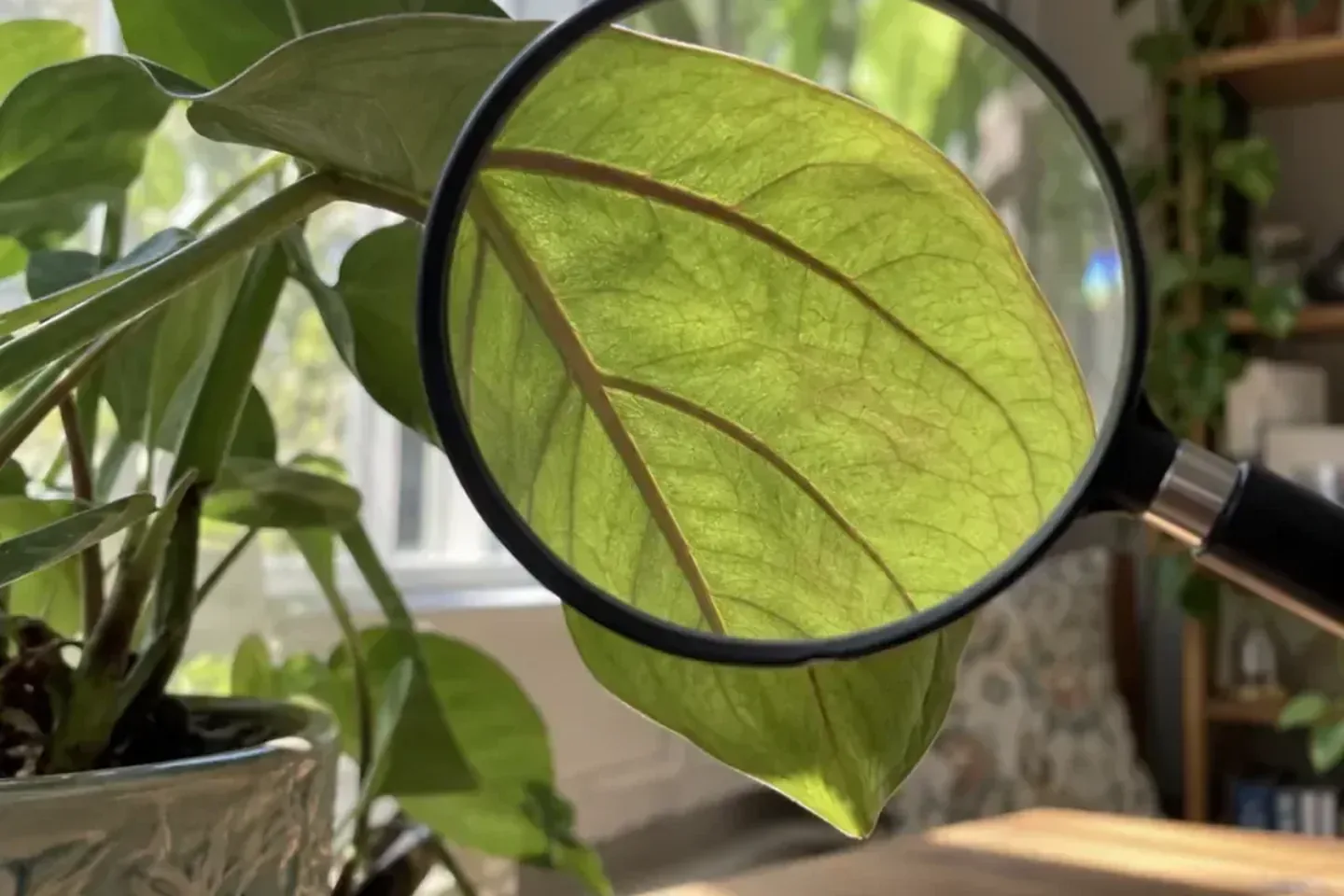
Pick four spots every time. The underside of a damaged leaf. The underside of a healthy-looking leaf. A growing tip. The joints where leaf stalks meet the stem. Then look at the pot rim and any stake or moss pole, because pests travel along those too.
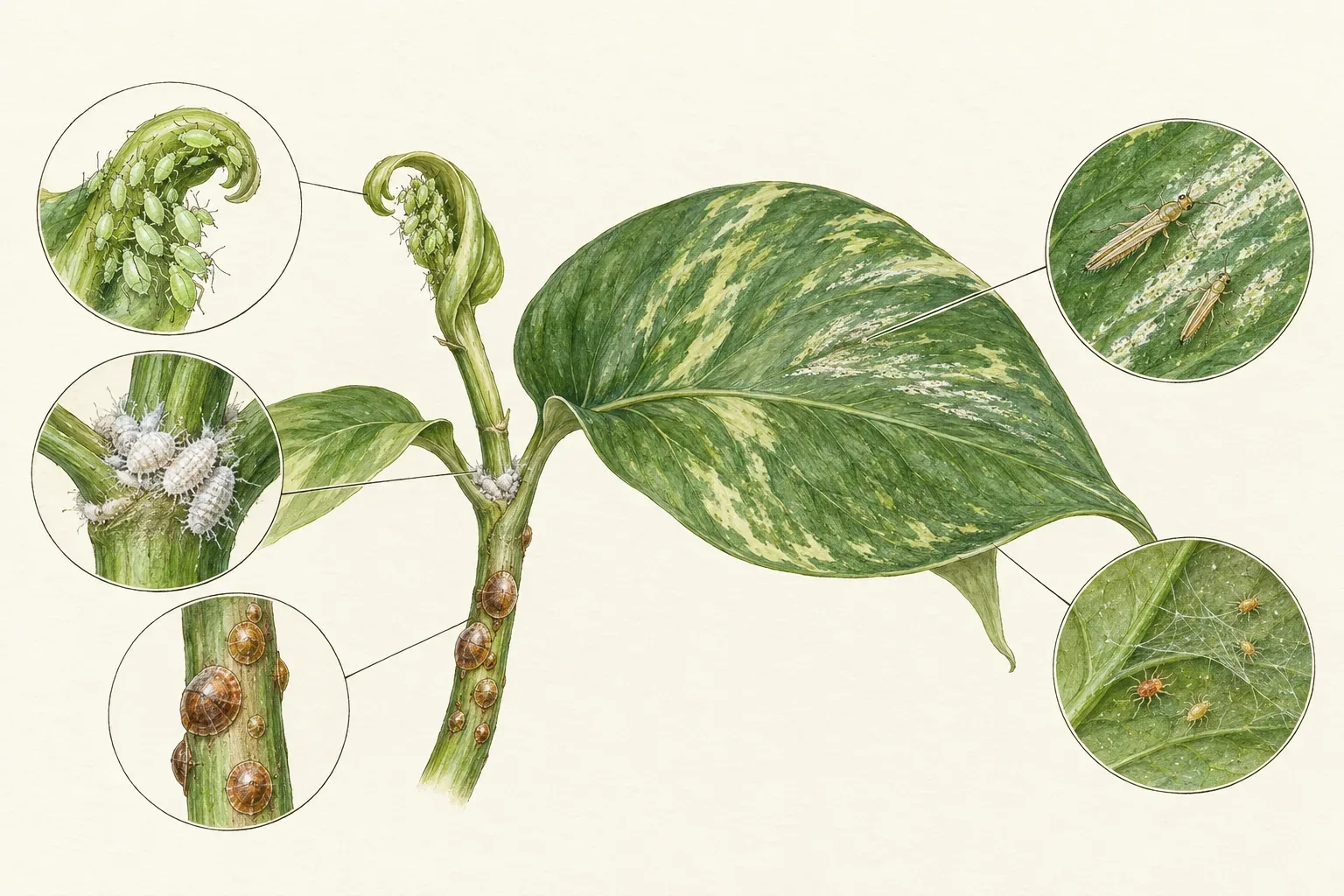
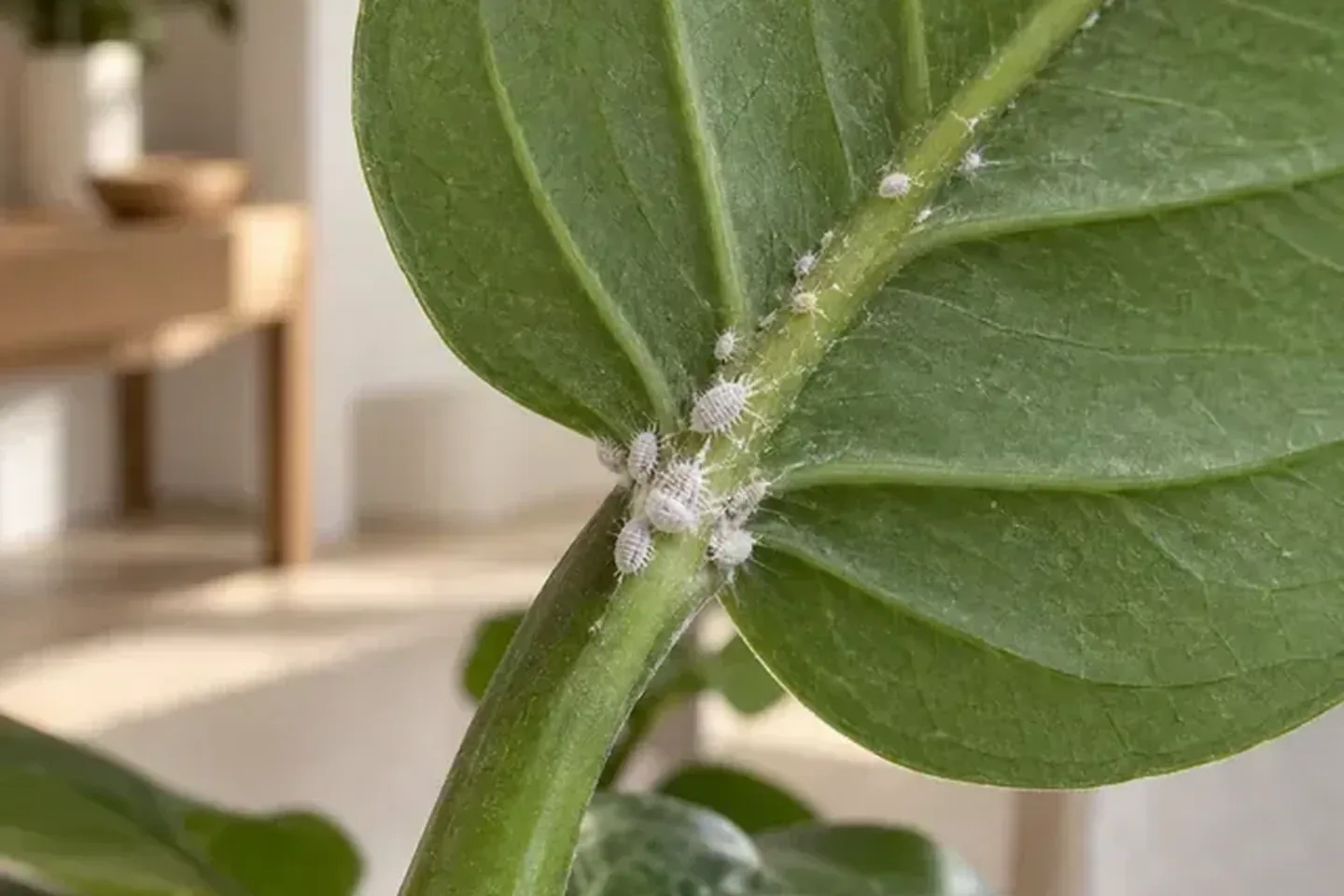
Shape and behavior tell you more than color. Cottony clusters at the joints point toward mealybugs on plants. Hard, fixed, shell-like bumps on stems and veins suggest scale insects. Tiny, slender insects that move, with silvery streaks on the leaf, fit thrips. The RHS thrips page shows the pale, silvery damage they leave.
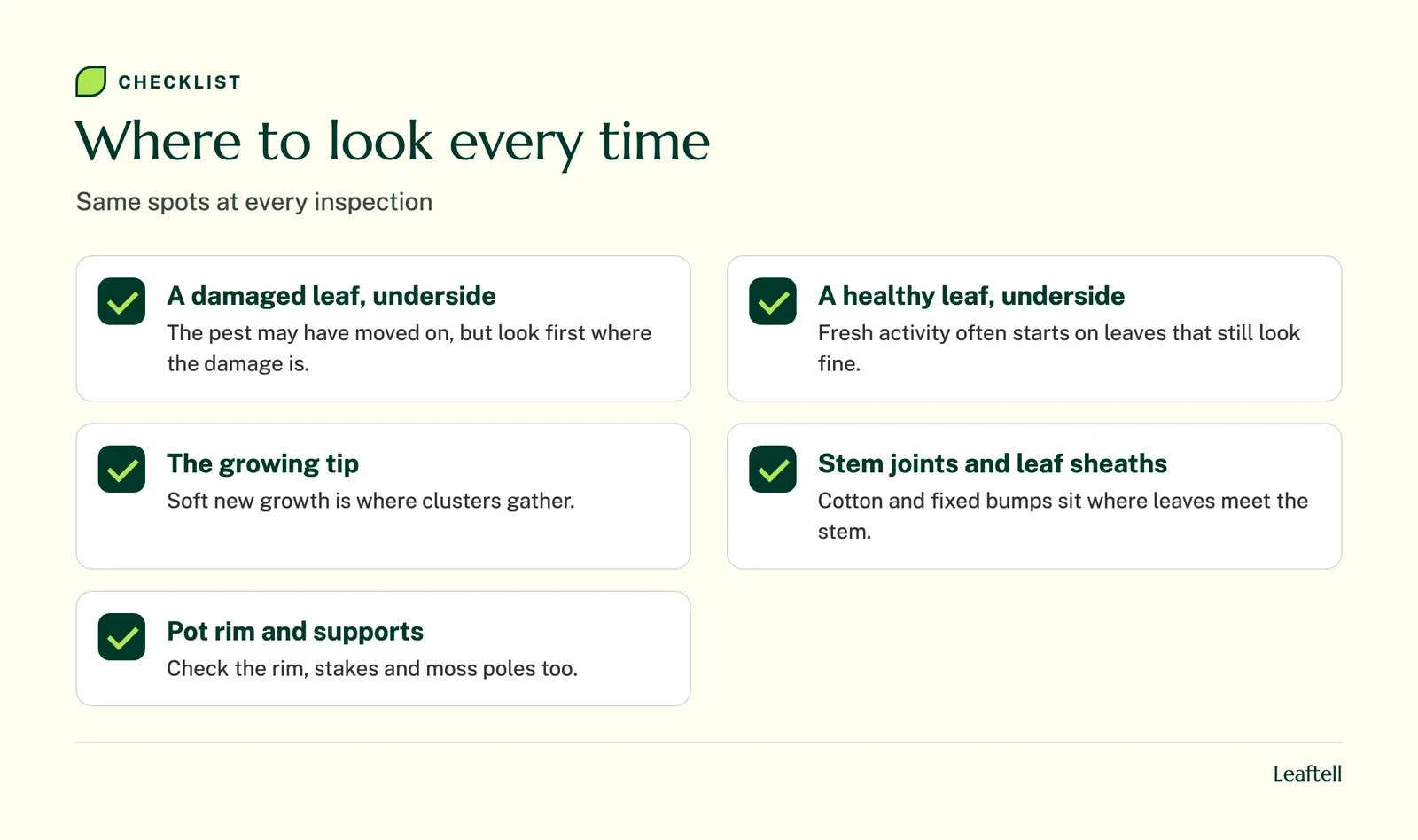
Not every pale speck is alive, and not every insect near a plant is eating it. Photograph what you find before you wipe it away. Get one shot that shows where on the plant it sat, then a closer one if your camera can focus. Do not blow up a blurry picture until dust starts to look like a bug.
Indoor plant pests identification pictures: match the clue to the pest
Pictures help, but the clue you write down is what narrows the list. Use the table below as a first sort, then confirm with a closer look before you treat anything.
| What you see | Most likely group | Where to look next | First move |
|---|---|---|---|
| White cotton at stem joints and leaf bases | Mealybugs | Hidden leaf bases and sheaths | Isolate, wipe off what you can reach |
| Hard brown or tan bumps that do not move | Scale | Stems and veins, not just leaves | Isolate, check every stem |
| Fine pale stippling plus delicate webbing | Spider mites | Leaf undersides, with magnification | Isolate, rinse undersides if the leaf tolerates it |
| Silvery streaks with tiny dark specks | Thrips | New growth and the streaked leaves | Isolate, photograph the insect itself |
| Clusters of small soft insects on new shoots | Aphids | Tender tips and buds | Isolate, rinse or wipe the tips |
| Small flies rising from damp mix | Fungus gnats | The soil surface and saucer | Fix the moisture, not the leaves |
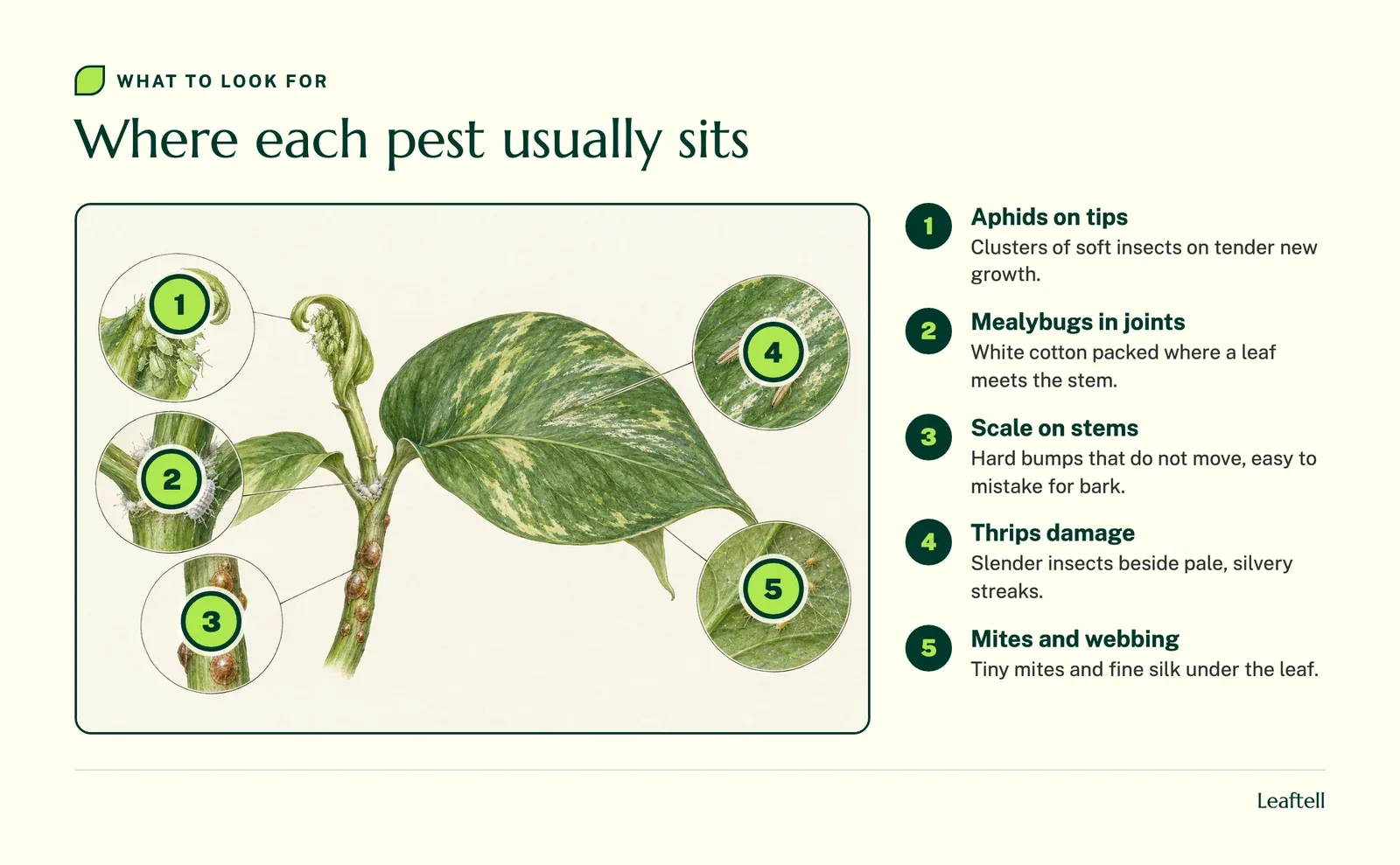
Scale is easy to miss, because a fixed bump on a stem looks like part of the plant. The RHS scale insect page is worth a look before you decide a bump is just bark. Check stems as well as leaves.
Sticky film is a clue, not a name. Some sap feeders leave honeydew, but plants can secrete droplets and old sprays leave residue too. The sticky leaves guide walks through that difference. If clusters sit on soft shoot tips, compare aphids on houseplants next.
Several pests can live on one plant at once. Keep a separate note for each plant in a mixed collection, so one shared spray routine does not miss a pest on one plant while dosing three plants that never had a problem.
Tiny bugs in houseplant soil or on the leaves?
Tiny bugs in houseplant soil are usually a different problem from bugs on the leaves. Small flies that rise from damp mix point to fungus gnats, whose larvae live in the growing medium, so a leaf spray does nothing for them.
Watch where the insects spend their time. Flies that lift off when you water or disturb the surface, and that hang around the pot rather than the fruit bowl, belong in the fungus gnat guide. That fix starts with the soil environment: drainage, debris on the surface and how long the mix stays wet.
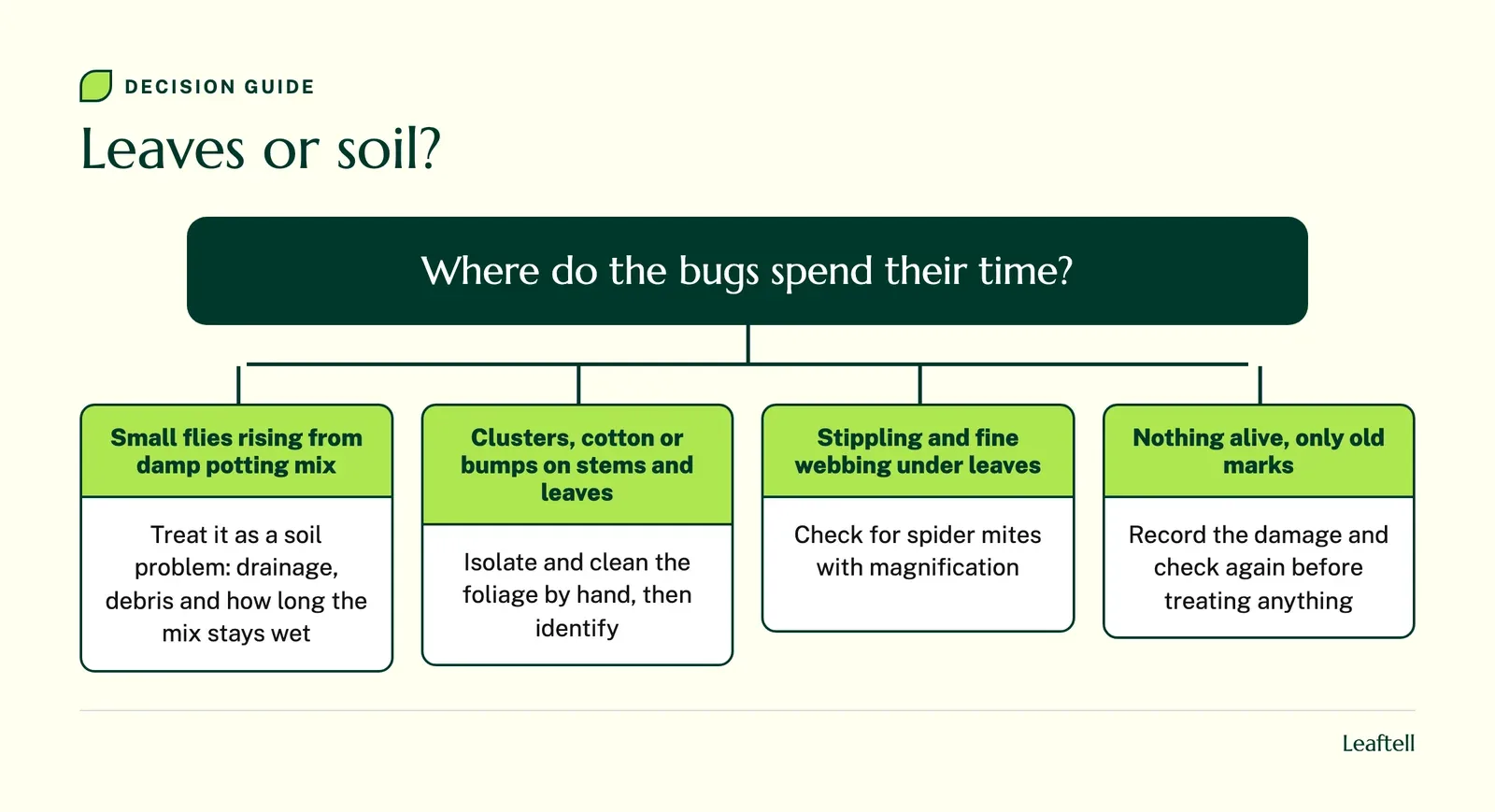
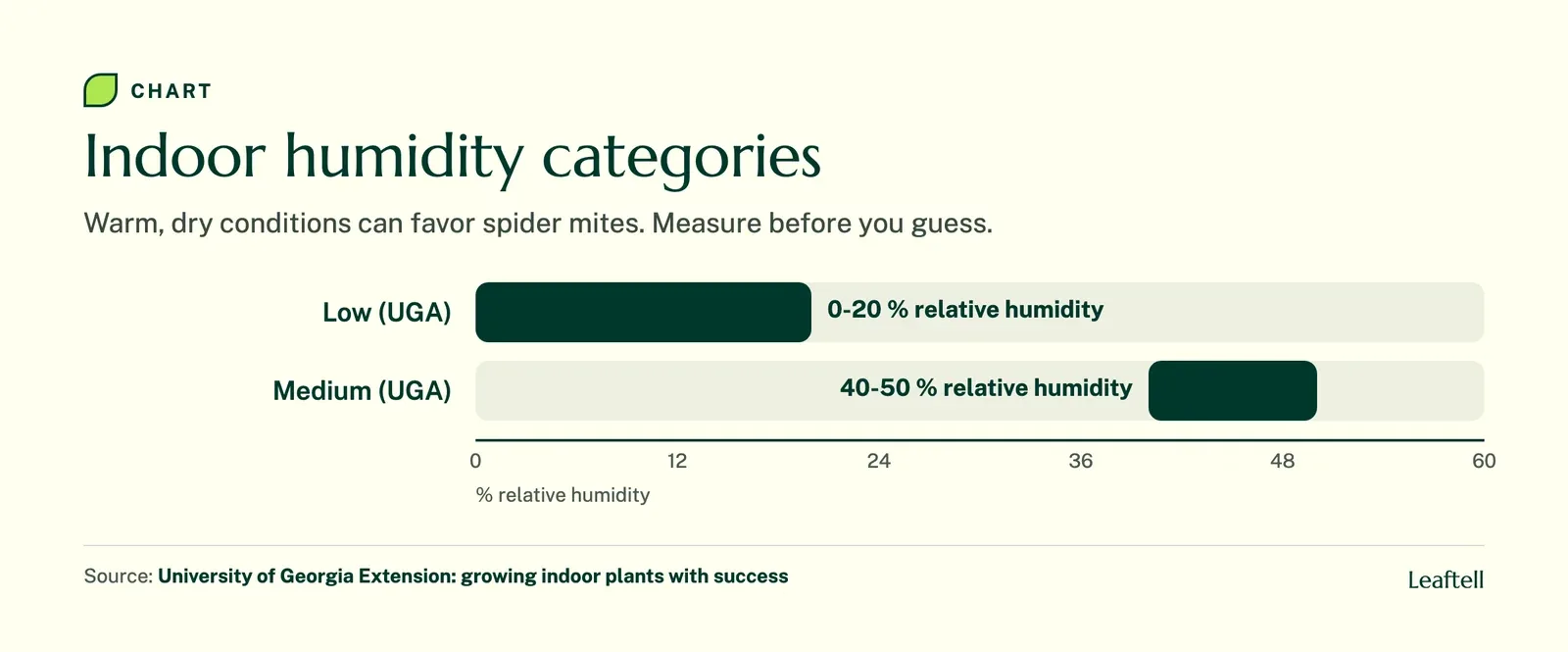
Fine stippling with delicate webbing is a different story again. Spider mites are not insects, and a product that works on an insect pest may do nothing for them. Compare spider mites on plants before you buy anything labeled "bugs". Warm, dry air can favor mite populations, so a plant next to a radiator or heating vent deserves the first look.
A generic word like "bugs" lets you skip identification. Do not let it. Look for the organism and its location, not just the plant's decline.
How to get rid of bugs on indoor plants, soil and leaves
Start with the least drastic step that works: separate the plant, clean what you can see and remove fallen debris. Most first rounds need nothing more than a damp cloth, a gentle rinse and a clean shelf.
How to get rid of houseplant pests without making things worse
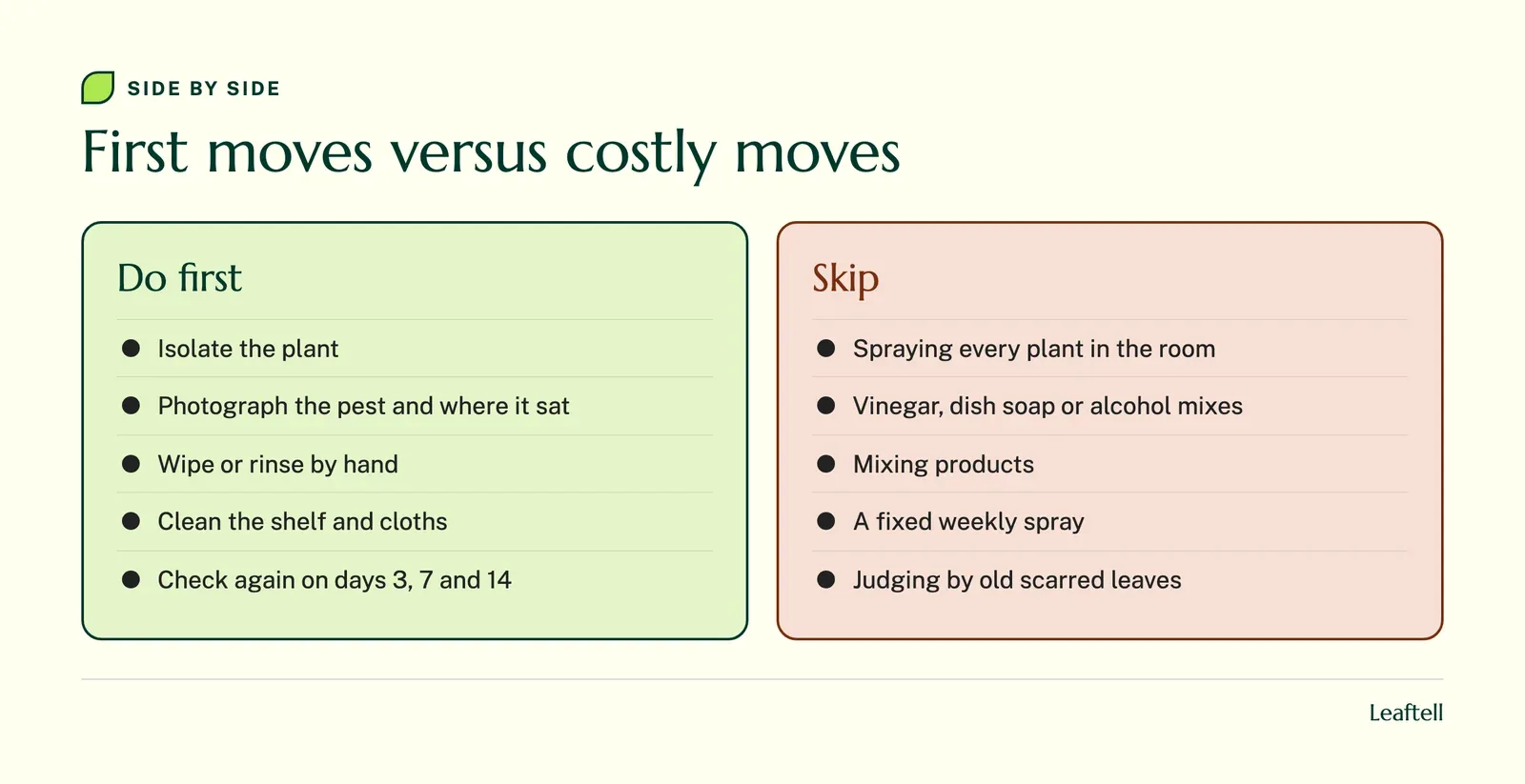
- Isolate the plant
Move it far enough away that its leaves touch nothing else, but keep its light and temperature suitable. Do not carry a dripping pot over healthy ones.
- Photograph before you clean
Take a whole-plant photo and close-ups of the pest and where it sat. That gives you a baseline for the next check.
- Remove what you can reach
Wipe or gently rinse leaves that can take it. Support each leaf, and go softer on delicate or hairy foliage than on tough glossy leaves.
- Protect the root zone
Keep extra rinse water out of a pot that is already wet. Let the mix and the shelf dry before the plant goes back.
- Clean the area
Clear fallen leaves, wipe the shelf and wash or discard cloths before you touch another plant. Inspect the plants that stood right beside it.
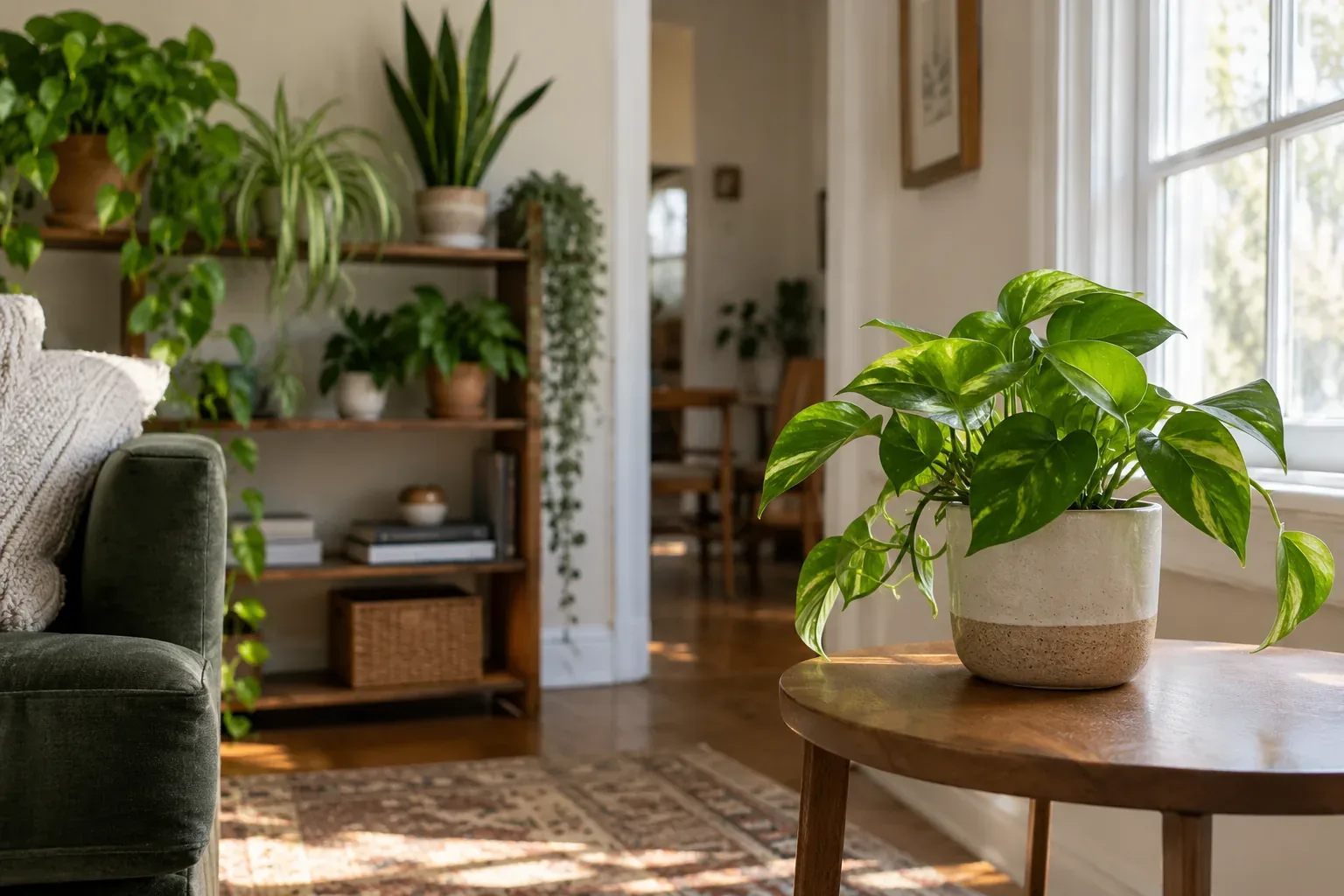
Isolation is a chance to watch the problem, not a punishment. A plant parked in a dark corner gets weaker and harder to read. On a trailing vine, follow each stem from the soil to the tip, because pests sit in the crowded center where leaves overlap.
Check the newest growth and the sheltered joints again after cleanup. A plant can look clean from above while pests stay under leaf sheaths or along veins. Write down which parts you cleaned so the next check can tell survivors from old damage.
When cleanup is not enough: choosing a treatment class
Reach for a product only after you know the pest and the plant. Insecticidal soaps and horticultural oils are product classes, not interchangeable recipes, and the label has to cover the pest, the plant and indoor use.
Follow the label for how to apply it, how often to repeat, temperature limits and any small test patch. Never mix products to make something stronger. Write down the product and the date, because leaf injury from a treatment can look like the infestation getting worse.
Keep children and pets away from products and wet foliage as the label directs, and store everything out of reach. The ASPCA toxic and non-toxic plants list tells you whether the plant itself is a risk to a cat or dog, but it does not tell you whether a pesticide exposure is safe. If you suspect exposure, call your vet or a poison service with the plant and product names.
Houseplant pest mistakes and what they cost
The most expensive mistake is treating before you identify. It wastes a week, hurts leaves and lets the real pest keep feeding.
- Spraying the whole collection. One unexplained mark is not a reason to treat every plant. You expose healthy plants and still may not hit the real pest.
- Kitchen sprays. Dish detergent, vinegar, concentrated essential oils and improvised alcohol mixes can injure leaves. The damage then gets mistaken for a worse infestation.
- Judging by old leaves. Feeding scars stay after the pest is gone. If you wait for old leaves to look perfect, you will keep treating long after it stopped being useful.
- A fixed weekly spray. Pest development varies by species and room conditions. Any repeat interval comes from the product label, not from a calendar.
- Hiding the plant. An isolated pot out of sight is a pot you forget to check.
How to get rid of flying bugs on indoor plants: check again on days 3, 7 and 14
One cleanup is a start, not proof that every life stage is gone. Look again on days 3, 7 and 14, in the same places each time, and count live insects rather than judging by how the leaves look.
These dates organize your inspections. They are not treatment intervals; those come only from a product label. For flying bugs around damp mix, compare how many adults you see over the same length of time at each check, and look at the soil surface and saucer, not just the air.
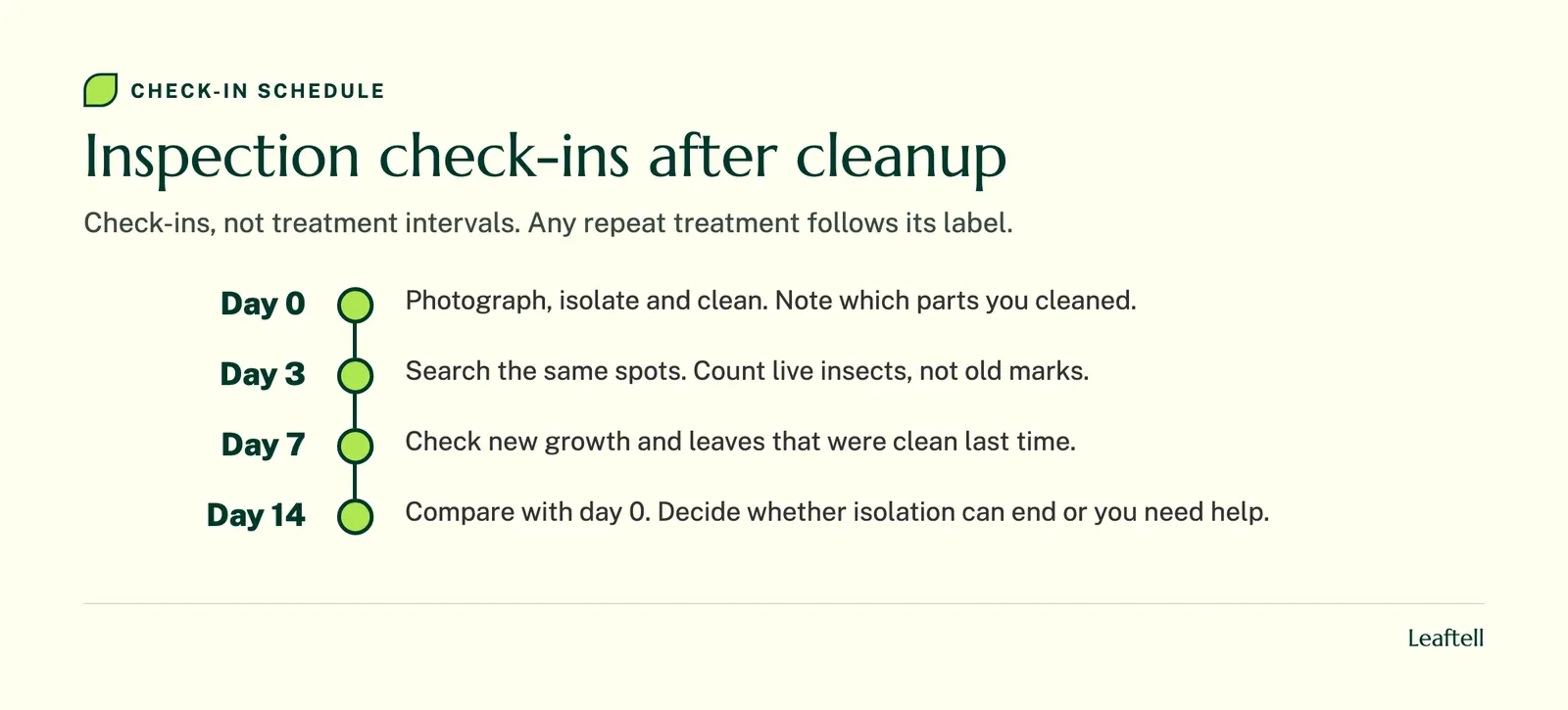
Look at healthy new growth and at leaves that were clean last time. Fresh damage on a previously clean leaf is the signal that matters. Keep the plant isolated while you are still unsure, and check its neighbors without automatically treating them.
If the evidence starts pointing at moisture or disease instead of insects, switch tracks. Discrete spots with defined edges may be a leaf spot problem rather than feeding damage.
Identify, isolate, then clean: the order that saves plants
If you remember one thing, make it the order: find the pest, separate the plant, clean by hand, then check again on days 3, 7 and 14. Most pest problems that go badly skip the first step and jump straight to a spray.
Get help when the pest spreads fast, when the base of the plant starts to collapse, or when the plant keeps declining after you have cleaned it and corrected its conditions. The University of Maryland Extension guide to indoor plant problems is a good place to start, and your local extension office can tell you what evidence they need. Bring close photos of the insect, the plant's name, where on the plant you found it and everything you have already tried. For a valuable or sensitive plant, ask about nonchemical options, and whether continued isolation or letting the plant go is more practical than round after round of treatment.
Sources
Check your growing conditions with the plant watering calculator.
Frequently asked questions
The common groups are aphids, mealybugs, scale, thrips, spider mites and fungus gnats. Where you find them and the marks they leave are the fastest way to tell them apart. Some small organisms in potting mix are harmless.
Look at the shape, the behavior and the location: cotton at the joints, hard bumps on stems, webbing with stippling, silver streaks or flies at the soil. Photograph it with a hand lens if you can. If you are still not sure, ask your local extension service with clear close-ups.
Start with the nursery label, then compare clear photos of the whole plant, a leaf and the stem against a reliable plant reference or ask an extension adviser. Knowing the plant matters, because leaf toughness and toxicity change how you clean and what you can use.
No single pest is always the hardest. Hidden stages of thrips, scale and mealybugs make follow-up checks important, and new plants can bring the problem back. Difficulty depends on the pest, the shape of the plant and how often it gets reintroduced.
Avoid it. Vinegar on foliage can injure the plant and does nothing to identify the pest. Start with isolation and physical removal instead.
There is no universally safe homemade spray. A rinse or careful hand removal helps with some pests. If you need more, use a labeled product class that matches the pest you confirmed.
Household dish detergent is not the same thing as a labeled insecticidal soap and can damage leaves. Use a product made for plants, matched to the pest, and follow its label.
Not usually on the first sign. Isolate it, clean it and check it on days 3, 7 and 14. If a weakened plant keeps losing ground and risks the rest of your collection, letting it go can be the practical call.
Share article
About the author

Keep checking your plant
Plant care reference
Indoor plant care
Build a routine around your plant, light and potting mix.
Plant care reference
Why is my plant dying
Trace leaf and root symptoms before choosing a care change.
Plant care reference
Pothos plant care
Choose a growing spot and prune a trailing pothos for fuller growth.
Plant care reference
How to fix root rot
Inspect root firmness and drainage, then decide whether to repot.